Tweezers for Eyelash Extensions
Beautiful, thick eyelashes are not always a gift from nature. Very often, they are the result of extensions—a popular beauty procedure that allows for a significant increase not only in length but also in volume through the attachment of artificial hairs using a special adhesive. To ensure that the extended eyelashes harmonize with the client's appearance, the technician shapes the curl taking into account individual facial features—such as the shape and position of the eyes, the width of the eyebrows, and the line of the cheekbones. This involves meticulous, almost jewel-like work, the success of which largely depends on the quality of the materials and tools used.
Contents
- Volume or Naturalness?
- What Should Be in the Technician's Arsenal?
- An Important Detail: Timely Sharpening
Volume or Naturalness?
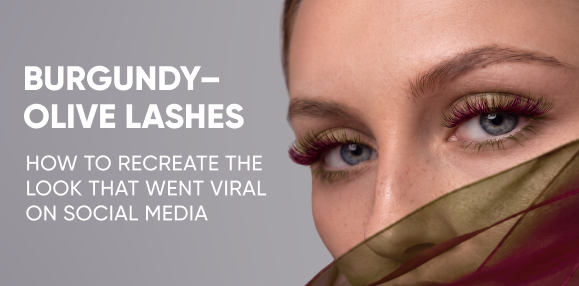
Today, the beauty industry offers various types of eyelash extensions, performed in salons or at home. The bouquet technique allows for maximum volume: several artificial hairs (ranging from 2-3 to as many as 13) are attached to each natural eyelash, giving the gaze a special expressiveness. This effect is created by properly executed bouquet eyelash extensions (photo):

Traditional eyelash extensions (classic) guarantee maximum naturalness, as one synthetic hair is strictly attached to each natural eyelash. Simple yet aesthetically flawless effects of eyelash extensions are achieved (photo):

What Should Be in the Technician's Arsenal?
Neither bouquet nor classic eyelash extensions can be performed without the use of consumables and tweezers of two different types. A straight tweezer is a supplementary tool that is held in the non-dominant hand during work and is used for separating eyelashes. It allows for the careful isolation of a single natural eyelash, to which one or more artificial hairs will be attached. Therefore, truly convenient straight tweezers for eyelash extensions should be as thin and straight as possible, with high-quality sharpening. Additionally, they should fit comfortably in the hand (from this perspective, each technician selects the tool "to their liking").

When choosing a straight tweezer, ensure that its tips meet precisely and close tightly, without misalignment or gaps. The pressure strength also matters. If it is too low, working with small details will be more difficult, while a tool that is too rigid will quickly tire the hands. A versatile option is a tweezer of medium stiffness with an opening width of up to 6-7 mm. Models with a so-called satin finish, which do not slip in the hand, are extremely practical.
A curved tweezer is the primary working tool, and its quality must meet special requirements. It is with this tool that artificial eyelashes are installed or eyelash bouquets are formed. When selecting a curved tweezer, pay close attention to:
- the shape and width of the working surface;
- the length of the handle;
- the convergence of the tips and surfaces along the entire length;
- the pressure strength;
- the quality of the sharpening.
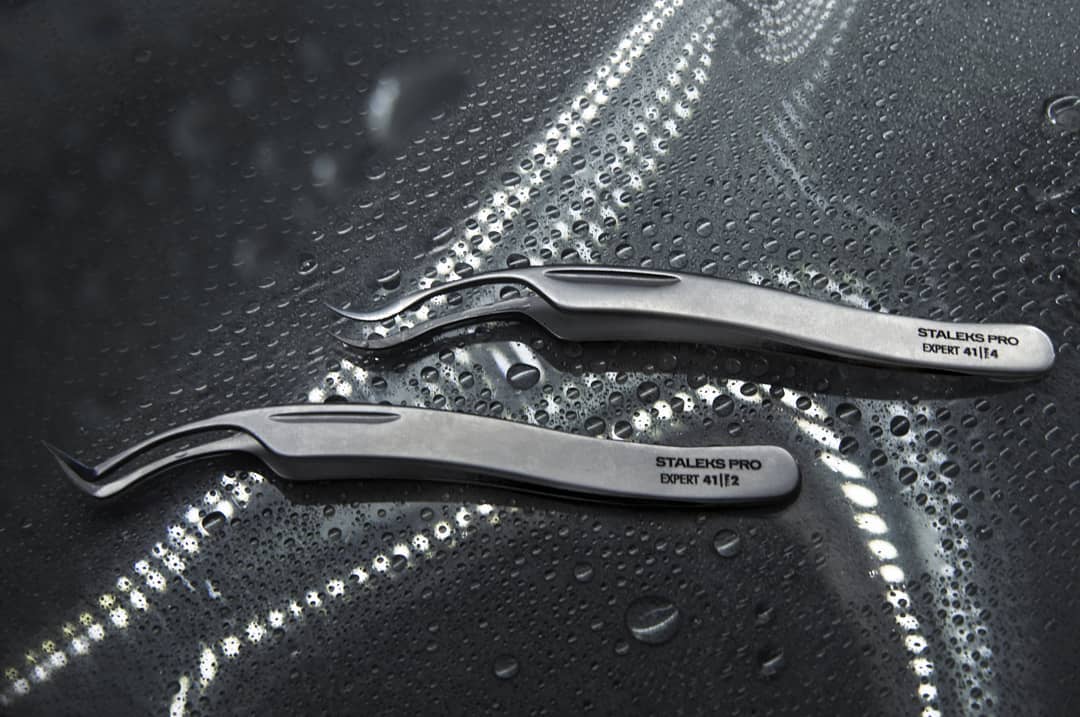
The tweezer for bouquet extensions is also chosen based on the technique the technician uses. The shape of the bend can be any—"axe," "arc," "mini-L"—this is more a matter of personal preference. However, ensure that the tweezer is well-sharpened, fitted, and does not wobble; otherwise, it will not be possible to form a neat bouquet. For the eyelashes to hold firmly and look beautiful after extension, their base should not spread apart (the bouquet opening begins approximately 1/3 of its length), and if the surfaces of the tweezer are poorly sharpened or misaligned by even half a millimeter, the hairs will inevitably spread apart during the connection process.
When selecting a curved tweezer for bouquet technique work, the length of the working surface also matters: the more hairs in the bouquet and the wider its opening (maximum 5 mm), the longer the surface should be, and the more pronounced the bend. If the technician does not work with a large volume, limiting themselves to "classic" or mini-bouquets of 2-3 eyelashes, the main manipulations can even be performed with two straight tweezers or one straight and one slightly curved.

An Important Detail: Timely Sharpening
Even a high-quality tool becomes less sharp and less convenient to work with over time. Unfortunately, the requirements for sharpening are not always mentioned in courses and lessons for technicians. How to sharpen tweezers for eyelash extensions? First, do not attempt to do it yourself—entrust the sharpening to a professional to avoid ruining the surface. Second, do it in a timely manner—under regular use, a good tweezer needs sharpening every eight to ten months. By the way, you should have at least one spare set of tweezers in your arsenal for this purpose.
Low-quality tools break down much sooner, sometimes just a few weeks after not overly intensive use. To avoid regretting your purchase, order tweezers only from trusted stores and pay attention to the thickness of the surface. A surface that is too thin may bend after the first impact against a table or another hard surface, while excessively sharp tips will injure fingers during work. You can buy eyelashes for extensions, a durable and safe adhesive for eyelash extensions, and the best tweezers of any size and shape online—at the online store staleks.ua.