Crooz PolyGel: Nail Extension, Strengthening, and Correction


 Buy
 Buy
 Buy
 Buy
 Buy
 Buy
 Buy
 Buy
 Buy
 Buy
 Buy
 Buy
 Buy
 Buy
 Buy
 Buy
 Buy
 Buy
 Buy
 Buy
 Buy
 Buy
 Buy
- 1
- 2
- Next

CROOZ Polygel is a hybrid material for nail modeling that combines the strength of acrylic and the flexibility of gel. This format eliminates the main drawbacks of classic systems: acrylic requires a monomer with a sharp odor, while gel lacks the rigidity for complex architecture. Polygel operates at the intersection of these two technologies, maintaining its shape without sagging while remaining pliable enough for sculpting. On the website staleks.ua, Crooz polygel is available in two formats – the thick NEW FORMULA in a tube and the more liquid version in a bottle with a brush, Liquid Polygel, including camouflage French for French nails and SHIMMER with shimmer.
What is Crooz Polygel and When is it Used
CROOZ Polygel belongs to modeling materials: it combines the properties of gel and acrylic and cures under a UV/LED lamp. This type of product addresses several tasks for the technician, as it is suitable for:
modeling the free edge;
restoring architecture after nail damage;
repairing chips;
overall strengthening of thin plates.
The purpose of a specific formula depends on its density: the thick composition holds the arch better and is designed for building length, while the liquid versions spread faster and are more often used for leveling, strengthening, and minor repairs.
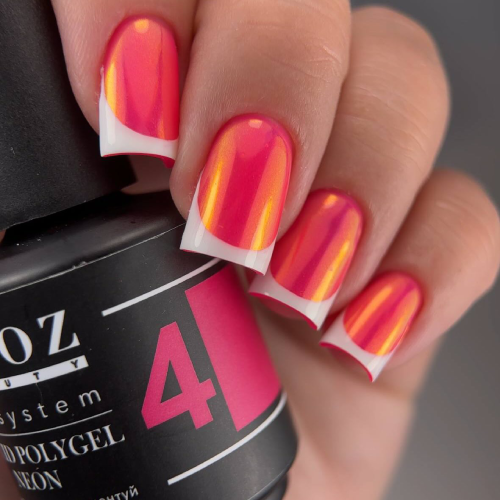
The area of application is not limited to salons. Cruz Polygel performs equally well for professionals experienced in acrylic sculpting, as well as for beginners and even those who do their own manicures – it forgives minor errors in material dosage and does not require the high speed of work like classic monomeric acrylic.
Technical Specifications
To make it easier for you to understand which CROOZ Polygel format to choose for a specific task, we have compiled the technical parameters into one table.
Characteristic | What it Means | Why it Matters |
Product Type | Three-phase polygel or liquid polygel | Determines the density of the material and the application approach |
Consistency | From thick sculpting to liquid self-leveling | Thick maintains shape without dripping, liquid saves time on leveling |
Texture | Non-granular, homogeneous | Affects the smoothness of the final coating and ease of filing |
Polymerization | UV/LED lamp with a power of 36-48 W for 120-180 seconds, wavelength 365-405 nm. | The specific range depends on the format, which affects the curing time of the layer |
Medium temperature drying mode | The material heats moderately in the lamp | Less likely to cause a sharp heat spike than high-temperature dense gels |
Shelf life | 36 months with proper storage | Allows for purchasing material in advance without the risk of spoilage |
Manufacturer | Ukraine | Simplifies logistics and reduces delivery time |
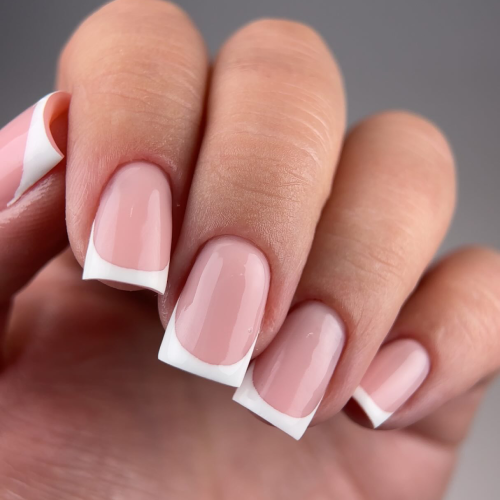
The combination of these parameters forms the working profile of the material: the density and consistency determine which technique it is suitable for and how it will behave during application, while understanding the polymerization regime helps establish optimal drying time and achieve a fully cured, durable layer.
Formats of CROOZ Polygel: How to Choose
The brand divides CROOZ polygels into two formats: thick and liquid, with the liquid further divided into three collections. It is important not to confuse them: each serves its own scenario. The table below provides a detailed comparison of key parameters.
Parameter | ||||
Volume | 30 ml | 15 ml | 15 ml | 15 ml |
Packaging | Tube without a brush | Bottle with a brush | Bottle with a brush | Bottle with a brush |
Consistency | Thick and dense, holds shape well | Liquid, spreads and self-levels | Medium, close to liquid, self-levels well | Medium: spreads gently, provides a hard coating after drying |
Finish | Dense, opaque | Camouflaging, semi-transparent | Colored or nude, semi-transparent | Semi-transparent, maximally natural, including with shimmer and glitter |
Application Behavior | Holds shape, requires sculpting with slip solution | Spreads on its own, does not overflow onto the sidewalls | Spreads on its own, does not flood under the cuticle | Does not flood under the cuticle and onto the sidewalls, self-levels in the layer, without shrinkage |
Main Action | Dense extension, building corners without a template | Correction, leveling, quick architectural repair | Strengthening, correction, leveling of the plate | Correction, strengthening, shimmering coating without a colored layer |
Additional Effects | Covers the plate as a standalone color, without a layer of gel polish | Camouflages tone for French, acid-free formula | Allows working in a filing-free technique | Shimmering shine, high wear resistance |
When to Use | Sculptural extension with a dense arch | Transition from thick material to a pliable formula | Strengthening and nude designs without colored gel polish | Desire to achieve a shimmering nude design in one layer |
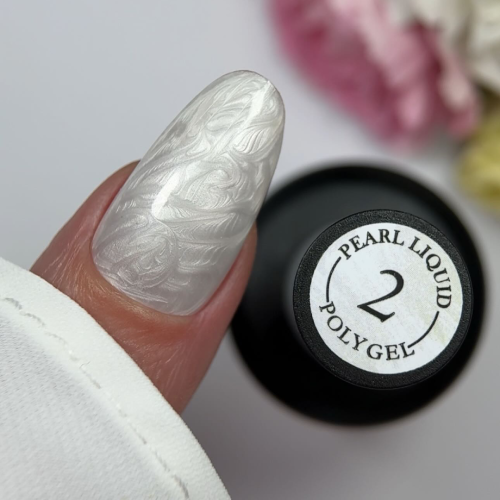
The table shows the main rule of choice: the denser the material, the more it is designed for volumetric extension and length, while the more liquid it is, the more it leans towards repair, strengthening, and fine adjustments of shape.
Palette and Shades
The color range of CROOZ polygel covers the entire spectrum from pure transparent base to rich tones:
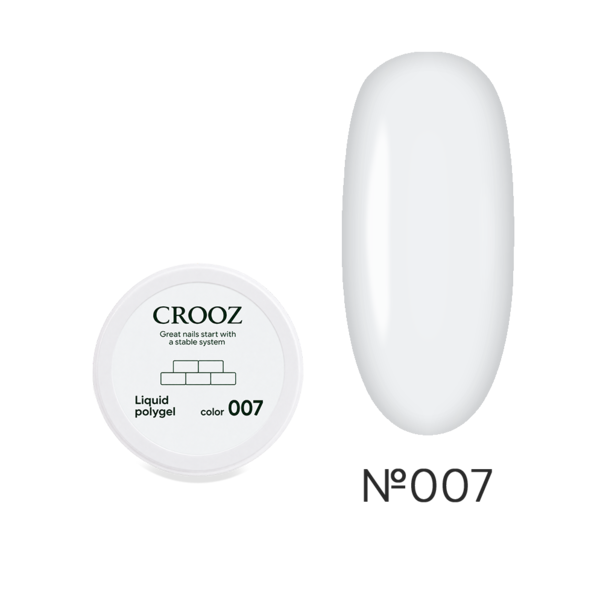
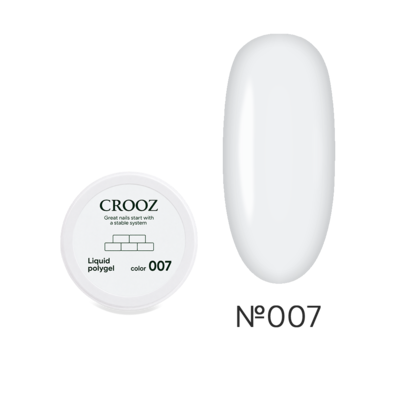
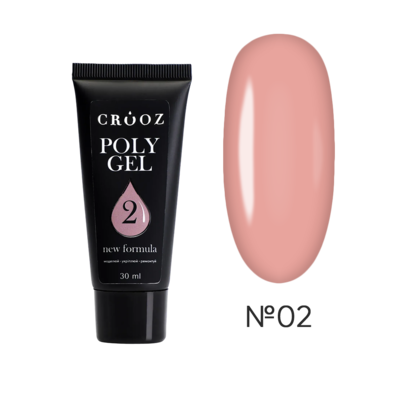
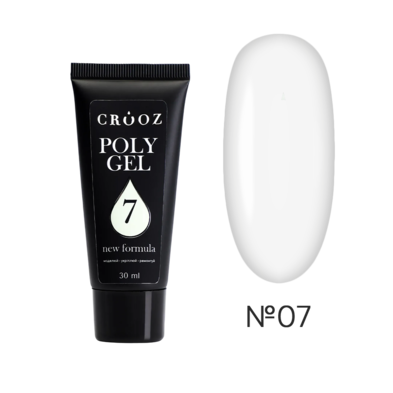
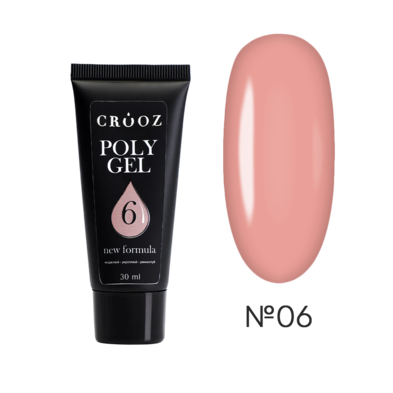
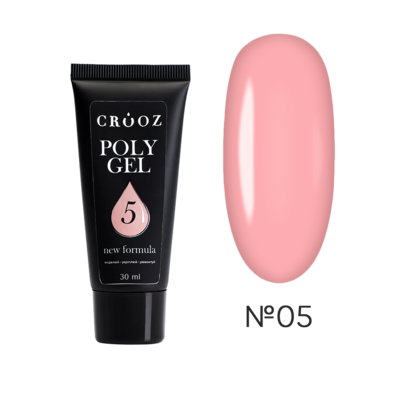
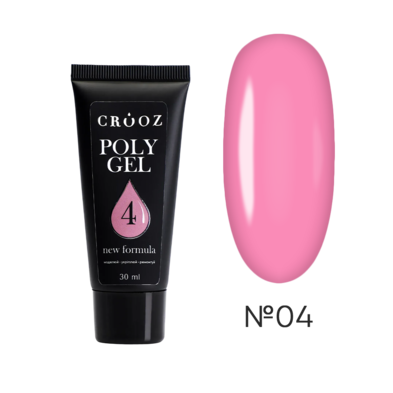
In NEW FORMULA available are transparent, milky-pink, candy-pink, coral-pink, and white – from light camouflage to dense opaque coverage, which works as a standalone color without an additional layer of gel polish.
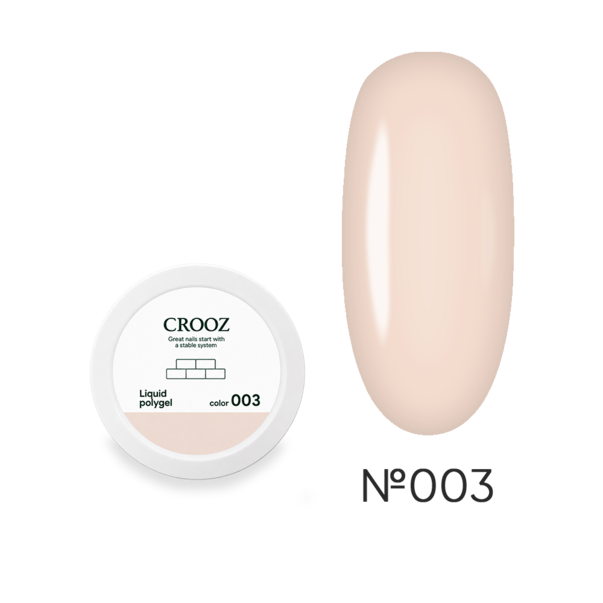
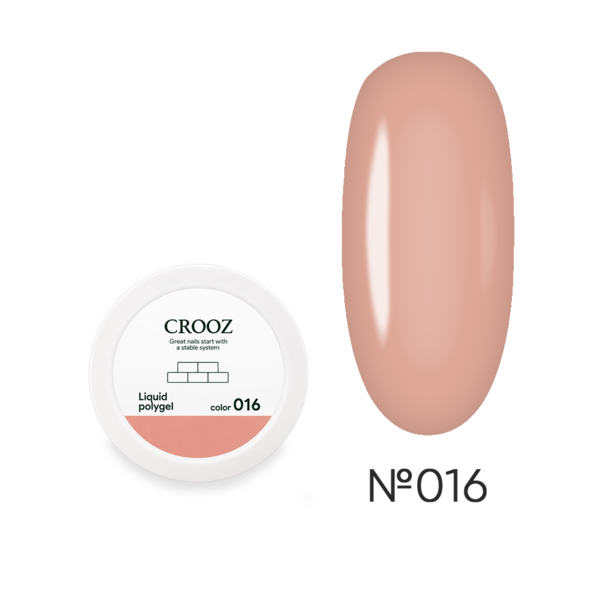
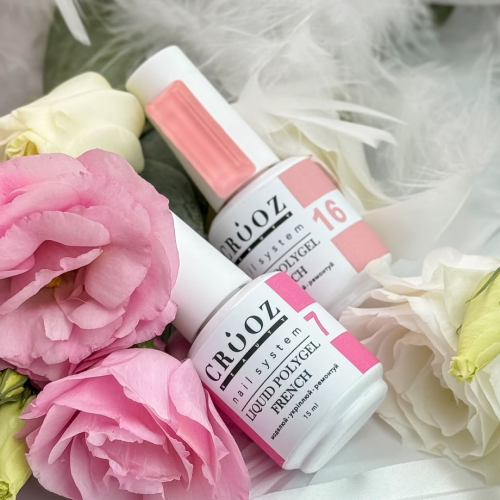
The basic collection Liquid Polygel adds colored and nude shades, including lilac and other tones, which work as a standalone light coating.
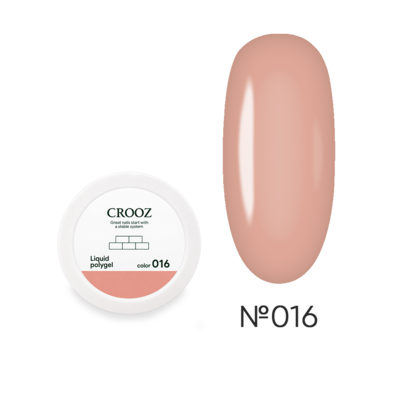
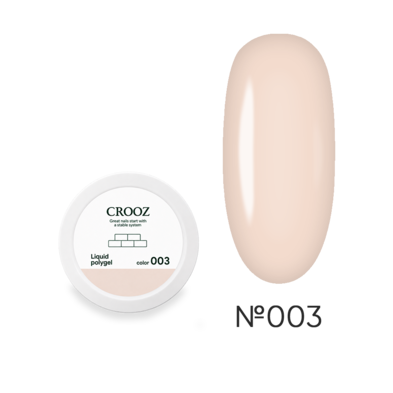
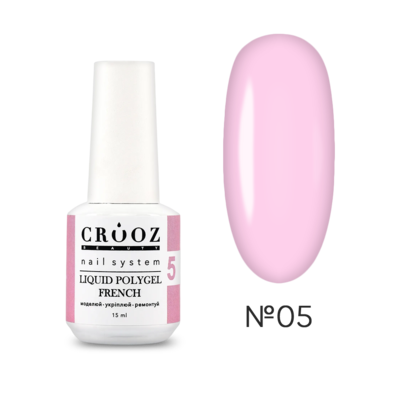
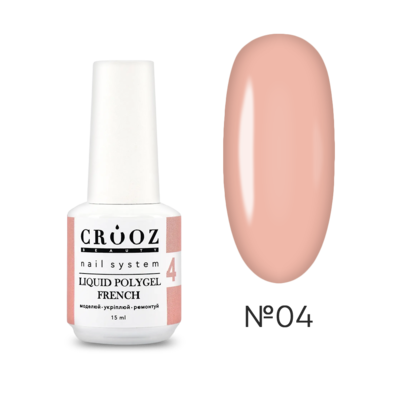
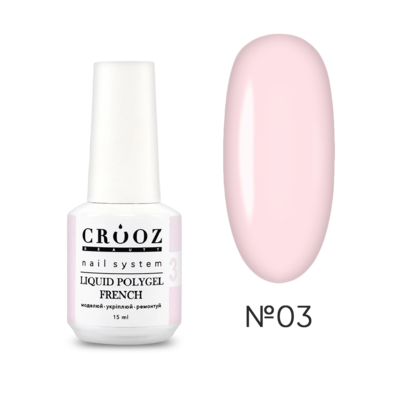
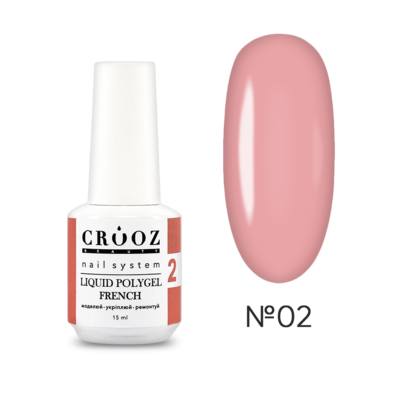
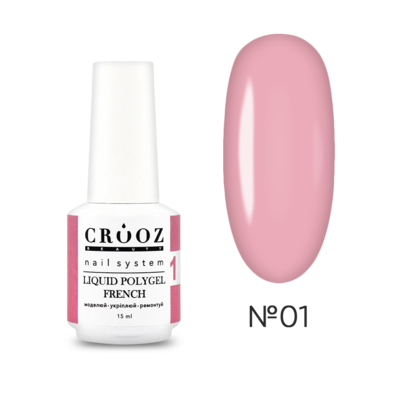
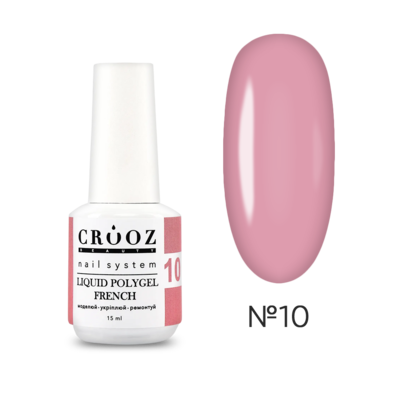
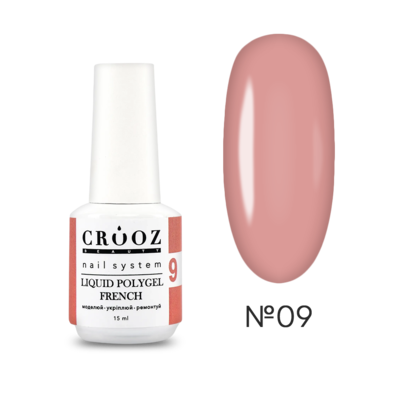
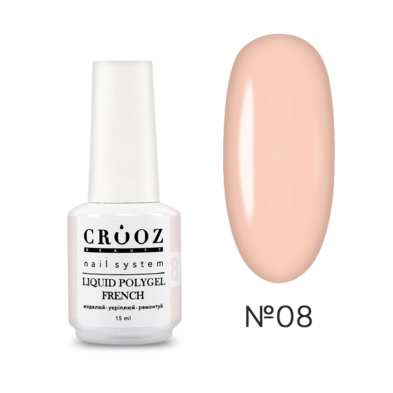
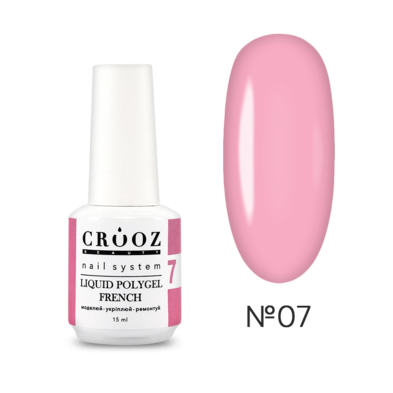
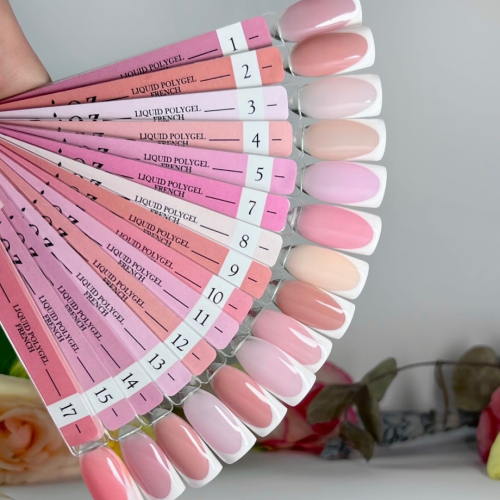
Liquid Polygel French offers a very wide selection: the camouflaging collection has nude pink, beige, coral, and lilac-pink shades for the classic smile line.
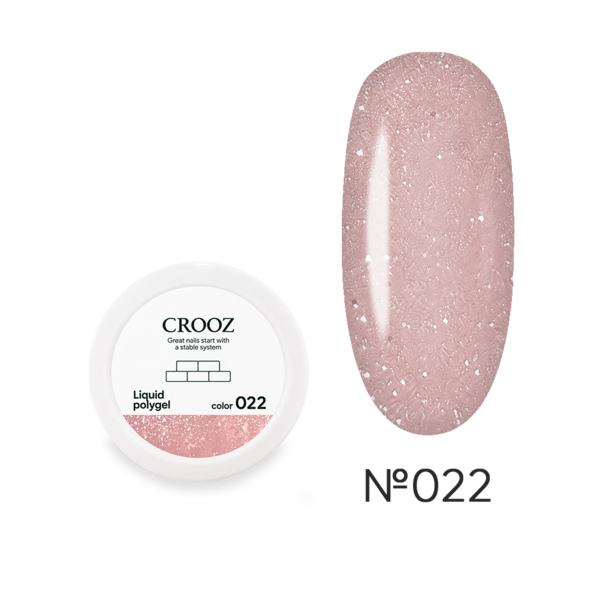
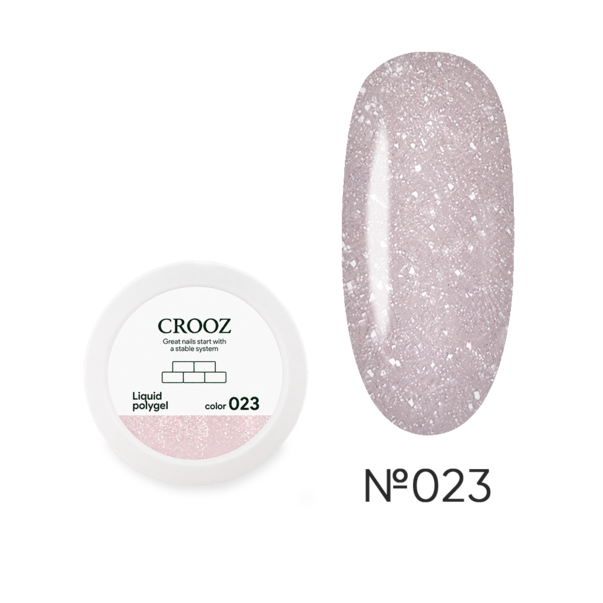
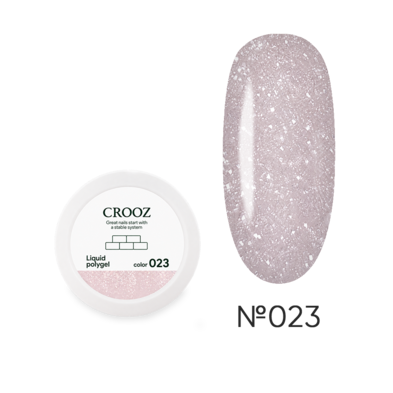
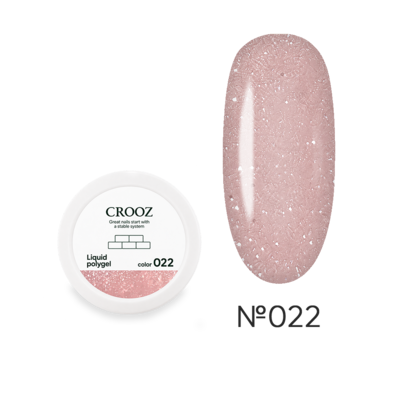
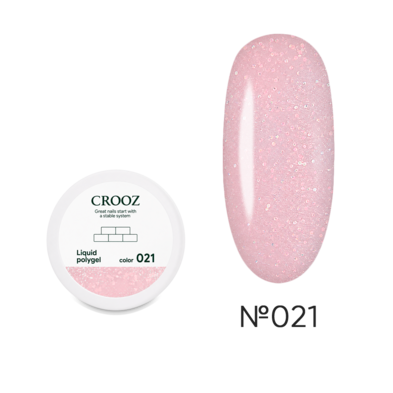
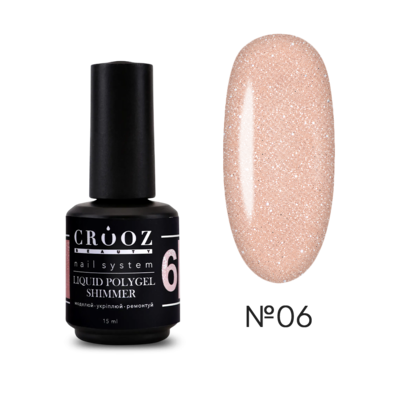
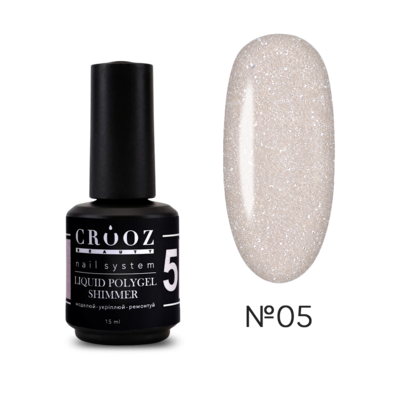
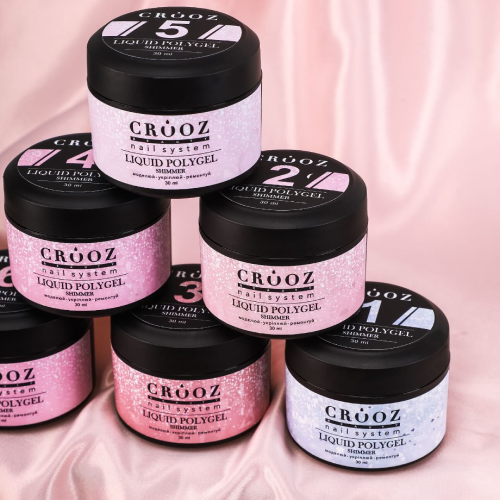
Liquid Polygel SHIMMER adds powdery pink and beige tones with silver shimmer and glitter within the mass.
Such coverage allows for selecting material for both strict nude and decorative designs with shine.
Active Properties of the Composition
The key effects of Cruz polygel, namely its mechanical properties, are determined by the chemical base. The framework of the formula is based on an acrylate copolymer: after polymerization, it forms a strong film that is responsible for the hardness and wear resistance of the coating. The compositions of the formats differ in this regard. The thick NEW FORMULA has an acrylate copolymer with polyurethane, as well as silica (Silica dimethyl silylate), which provides a dense viscous consistency and helps the material maintain the arch. In contrast, the liquid formulas Liquid Polygel, French, and SHIMMER utilize an acrylate copolymer with hydroxypropyl methacrylate – this gives a more fluid, self-leveling texture.
Photoinitiators are responsible for curing: under the lamp's beam, they trigger a reaction in which the liquid mass transforms into a solid network. In the thick formula, one initiator is used, while in the liquid ones, a second, more active in the LED range, is added. The completeness of this reaction determines the strength of the coating, so it is not recommended to shorten the drying time or lamp power: an under-cured layer may appear ready on the outside but remains soft and sticky inside.
It is also worth mentioning the comfort of working with the material. It does not require a separate liquid monomer, as classic acrylic does, so there is no sharp odor. However, this feature does not eliminate individual reactions to components, meaning one cannot claim absolute hypoallergenicity: before the first use on a new client, it is advisable not to neglect standard precautions, as with any photopolymer.
Technique for Applying CROOZ Polygel
The general algorithm is the same for all formats, while differences appear at the material distribution stage. Below is the sequence of steps that provides a durable coating with CROOZ polygel without peeling:
Perform mechanical preparation of the nail plate: shape with a file, remove shine with a buffer, treat the cuticle, and remove the pterygium.
Degrease the plate with a dehydrator to remove moisture and grease residues, then apply a primer for adhesion.
Cover the nail with a base – for polygel, a rubber base is preferred: it is more elastic than a regular one and absorbs the load at the junction with the heavy layer of material, reducing the risk of lifting on thin nails. Cure the base in the lamp according to the instructions. There is no need to remove the dispersion layer from the base before applying polygel – it is the dispersion that ensures maximum chemical adhesion between layers.
Pick up the material on a brush or spatula. For thick material, distribute it using slip solution – this is a special liquid that moistens the tool so that the sticky polygel does not pull with the brush and smooths easily. It is not part of the coating and simply evaporates; it cannot be replaced with alcohol or monomer. Liquid formulas (Liquid Polygel in a bottle) do not require auxiliary liquids – they are applied with the native brush while forming a leveling layer and given 2-3 seconds for self-leveling.
For a pronounced transverse arch on the upper forms, use the "pinch" technique: after a short pre-polymerization of 10-15 seconds, lightly pinch the thick material from the sides with a clamp or fingers, fix the bend, and fully cure. This results in a voluminous and strong extension rather than a flat one. This technique is not applied to liquid formulas.
If the layer thickness exceeds 1.5 mm, work in several stages with intermediate polymerization to prevent the material from overheating and fully hardening.
Cure the coating in a UV/LED lamp. The guideline for Cruz polygel is 120-180 seconds depending on the layer thickness and the device's power.
If performing an extension on upper forms, remove the natural free edge of the nail from under the artificial layer. Since the natural plate is mobile and prone to twisting from moisture, without filing, it will eventually detach from the solid stationary polygel, forming detachments at the tip.
Remove the sticky layer, complete the intended design, and cover with a finishing top. Under camouflage shades, the top lays cleaner without a sticky layer – the tone remains pure.
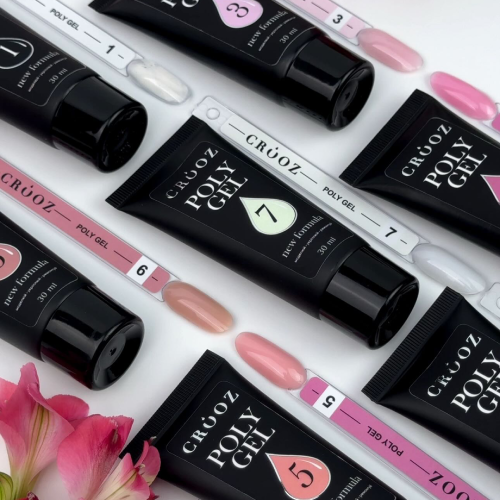
In the end, the difference is only in comfort and work pace: with thick polygel, the technician works with hands or a separate brush, while liquid formulas take on part of the tasks themselves. The durability of all formats is comparable when technology is followed.
Recommendations from Technicians
Practice shows that some problems with CROOZ polygel for nails are related not to the material itself but to violations of the working technology. A few tips will help achieve a clean result:
With liquid formulas, do not rush to correct the material with a brush: give it a few seconds to spread on its own and find its level, and only then adjust the edge. If you move the mass immediately, the surface will remain uneven.
When working with thick polygel, moisten the spatula or brush in slip solution before each movement. The material glides over the moistened tool and does not stretch, so the surface smooths out more evenly than with a dry tool.
Pick up thick material in small portions and build the shape layer by layer – this makes it easier to control the apex and prevent flooding under the cuticle.
Before stretching the material, place a small drop precisely in the apex area – the highest point of the future arch – and let it set for a couple of seconds without the lamp. It will serve as a height reference, and you won't tilt the arch towards the cuticle or tip while distributing.
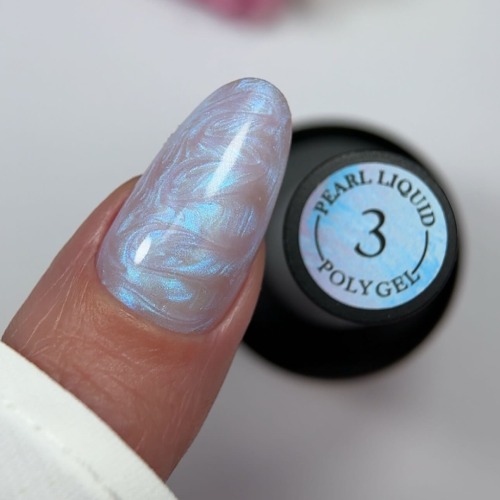
For a shimmering coating, choose a glossy top: under it, the shimmer appears brighter, while a matte top makes the shine deeper and more muted.
For a neat smile line in French, use a brush with a sharp tip – this makes it easier to draw a clear boundary.
Calculate the thickness for the task: a thin layer dries faster and looks more natural, while a thick one provides strength for length and complex architecture. The same formula behaves differently depending on how much material you apply.
Remember the boundaries of the material: polygel is strong where a balance of strength and volume is needed – for extension, strengthening, and restoring shape. If the task is narrow, such as achieving a very thin natural coating or very large length, it is wise to assess in advance whether it will suit the specific request or if it would be better to choose another material.
Adhering to these rules directly affects the final durability of the coating and the appearance of the manicure.
FAQ: Common Questions about CROOZ Polygel
Can thick and liquid formulas be mixed together? The manufacturer does not officially declare such compatibility: the formats have different polymerization mechanics and densities. Within one collection, shades from bottles can be mixed – this creates an intermediate tone of the desired intensity.
Is the material suitable for extension on tips? Yes, but the choice of format depends on the task. For construction, length, and arch, dense versions are used: they hold shape and provide strength on tips and upper forms. Liquid formats on tips work as a leveling and fine-tuning layer, not as a base for construction: they are convenient for finishing the surface and strengthening, but it is not advisable to build length on them.
Do the glitters in the shimmer polygel dull after filing during correction? No, the particles are distributed throughout the mass of the material, not just on the surface. After filing the top layer and reapplying the top coat, the shimmer remains intact.
How to tell when it's time to replace the material with a fresh one? Focus on the consistency: if the polygel starts to stretch into threads, delaminate, or change color, its shelf life is nearing the end, and it is time to order a new package.
What is the correct way to remove polygel from the nail? This is a modeling material, and it is removed by filing with a machine or file. Soaking in a polygel remover does not work.
Does polygel harm the natural nail? The material itself does not damage the plate. Problems arise from rough removal and excessive filing, so correction and filing should be done carefully.
Can painting, foil, or pouring be done over a finished coating? Yes, after removing the dispersion layer, the surface becomes a base for any decoration techniques, including watercolor and sliders.
Does the light camouflage shade yellow over time? With complete polymerization and coverage with a quality top coat, the tone remains stable. Yellowing is usually caused by under-curing or an unsuitable finish, not the material itself.
CROOZ Polygel in the Staleks Shop & Service Catalog
Cruz Polygel combines the strength of sculpting acrylic gel, the speed of self-leveling gel, and the decorative effect of shimmering formulas in one line. The technician chooses the format for a specific stage of work rather than adapting the technique to the material. The product confidently addresses the tasks of full extensions, precise corrections, and shimmering coatings without a separate colored layer.
In the online store staleks.ua, you can purchase CROOZ polygel for nails in various formats and a wide palette of shades. Ordering is easy with delivery across Ukraine and beyond.
CROOZ Polygel is a hybrid of acrylic and gel, polymerizing under a UV/LED lamp.
The catalog features two formats: thick acrylic gel NEW FORMULA in a 30 ml tube and liquid polygel in 15 ml bottles.
The liquid format is divided into three collections: basic Liquid Polygel, camouflaging French, and SHIMMER with shimmer.
The line includes over 40 items: 7 tubes of NEW FORMULA and 34 bottles, of which 6 are shimmering.
The palette includes transparent, milky, white, pink, and purple tones, as well as nude and shimmering versions.
The thick material holds the arch without dripping, while the liquid formulas self-level on the plate.
The base is an acrylate copolymer: NEW FORMULA includes polyurethane and silica, while the liquid Liquid Polygel, French, and SHIMMER contain hydroxypropyl methacrylate.
The material does not require a separate liquid monomer, unlike classic acrylic.
The shelf life of the sealed package is 36 months.
Production is located in Ukraine.